
GENERAL INDUSTRIAL / SPECIALTY
WHY SELF-LOCKING & BRAKING CYLINDERS?
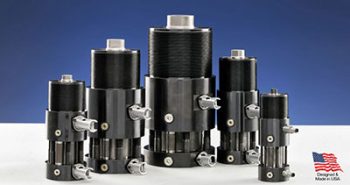
Self-Locking Cylinders and Brake Cylinders allow designers to defeat common barriers associated with hydraulic and pneumatic systems.
Locking Cylinders: Repeatable precise positioning along with high force holding capability is now attainable with PFA Self-Locking Cylinders. The metal-on-metal positive lock ensures "hard contact" repeatability and maintains position independent of system pressure. Because the locking mechanism physically blocks rod movement, common "spongy" air and hydraulic problems are eliminated. Once in the locked position, system pressure may be lost or removed without affecting position or load capacity.
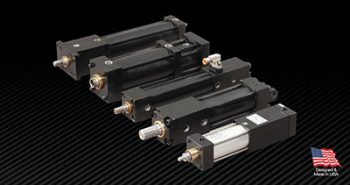
Braking Cylinders: Holding the rod in position when air pressure is lost is the typical use of PFA's Braking Cylinders. The internal rod brake allows holding in any position.
Modular Support
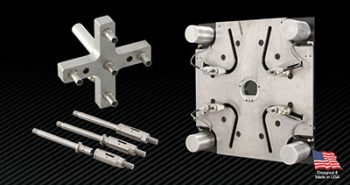
PFA's modular systems replace custom and complex systems, allowing for drop-in support. That means that during production runs, when your customers need to do a quick replacement, they can do it.
Some Examples
Lift and load devices, safety mechanisms, and non-drift applications are just three generic examples of possible uses. Specific examples include: foam molding, intermittent use lifting, movable platforms, staking, automated assembly, tooling fixtures, stamping, packaging and many more.
Simpler is Better
Often by eliminating the need for hydraulics, our pneumatic Self-Locking Cylinders and Braking Cylinders do the job better, faster, and at a lower cost, saving money in design, construction, and lifetime operation. For amazing hydraulic versions with 10x the holding force of standard hydraulic cylinders, try our HYS series.
Discover the Benefits of Control, Protection, Strength and Easy Operation with PFA Self-Locking Cylinders!
- Mechanical Lock Protection: True "rod interrupt" lock ensures full load capacity is maintained, even if system pressure is lost! (HYS/PVS)
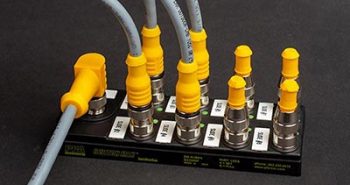
- Positive Locking Sensor Control: Senses actual locking action engaging to ensure positive machine control.
- Smooth & Easy Operation: Complementary angles allow for ease of lock engagement and disengagement even under load.
- Strong Compact Design: Integral locking mechanism allows for ease of installation and can hold the force of a cylinder 10 to 15 times larger!
- Standard Porting Flexibility: When cylinder reaches end of stroke the spring bias causes the lock to engage. Retract pressure (LOE) or extend pressure (LOR) is ported internally to unlock the unit, making a 2-port system. (HYS/PVS)
- Adjustable End of Stroke Cushioning: Metered exhaust allows for adjustable cushions at either end of stroke. (HYS/PVS/KPS)
HYS/PVS - Hydraulic/Pneumatic Self-Locking Cylinders
Lock-on-Extend (LOE) Style
Application
The Lock-on-Extend (LOE) Self-Locking Cylinder locks the rod in position when the rod is fully extended. Load force is applied to the rod in a direction such that it is pushing on the rod (compression). Lock prevents retraction.
Operation
The Lock-on-Extend (LOE) Self-Locking Cylinder employs a tri-sectional locking ring (three segments) and an annular groove to maintain a metal-on-metal mechanical lock regardless of system pressure. As the cylinder reaches end-of-stroke (extend), the tri-sectional ring is forced into the annular groove in the rod by the locking slide. The locking slide is held in place by the bias springs and will maintain lock-up until pressure is applied to the retract port. The retract port supplies pressure to move the locking slide off the three locking segments and to retract the rod at the same time.
Lock-on-Retract (LOr) Style
Application
The Lock-on-Retract (LOR) Self-Locking Cylinder locks the rod in position when the rod is fully retracted. Load force is applied to the rod in a direction such that it is pulling on the rod (tension). Lock prevents extension.
Operation
The Lock-on-Retract (LOR) Self-Locking Cylinder employs a tri-sectional locking ring (three segments) and an annular groove to maintain a metal-on-metal mechanical lock regardless of system pressure. As the cylinder reaches end-of-stroke (retract), the rod engages a keeper slide allowing the tri-sectional ring is forced into the annular groove by the locking slide. The locking slide is held in place by the bias springs and will maintain lock-up until pressure is applied to the extend port. The extend port supplies pressure to move the locking slide off the three locking segments and to extend the rod at the same time.
KPS Internal Braking Cylinder
Application
The KPS Internal Braking Cylinder is designed for long life when properly utilized. Ideally, the brake element should be engaged when the piston rod is no longer moving. Braking with the cylinder rod stationary will reduce the wear of the braking element and allow for precise positioning. Brake holds rod in any position.
Operation
PFA's KPS Internal Braking Cylinder provides the freedom to stop and hold a load anywhere along the stroke, without relying on air pressure to hold position. While the KPS functions like any other double-acting pneumatic cylinder during normal cycling, when air pressure is removed from the brake port the internal spring-loaded brake mechanism will engage. The brake mechanism consists of spring washers, cone, brake piston and mandrel. When air pressure is removed from the brake port, the spring washers force the piston to pull the cone into the brake mandrel. As the cone enters the brake mandrel, the mandrel (similar to a collet) is forced to spread, contacting the inside surface of the piston rod and effectively holding it in place. When pressure is applied to the release side of the brake piston, the spring washers are compressed, relieving tension on the brake mandrel and releasing the piston rod. The KPS cylinder rod is now free to move.